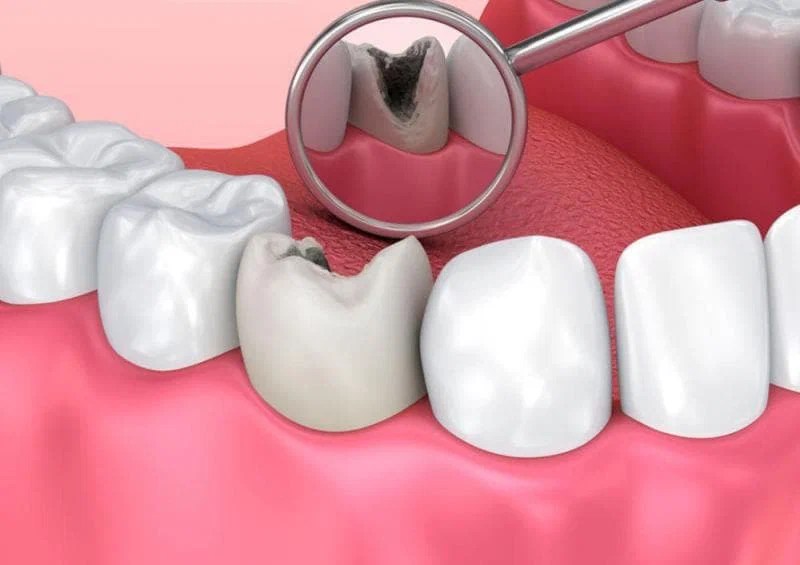
Pain when you drink something cold or hot, white spots on the teeth or inflamed gums. Recognizing cavities in teeth is not always easy. However, almost everyone experiences it at some point. Fortunately, there are several methods by which you can recognize cavities in the teeth.
The formation of cavities (caries)
Holes in teeth and molars are also called caries. It is shocking how often this already occurs in babies and toddlers. How do cavities form in teeth? This is all due to dental plaque, a sticky layer that harbours bacteria.
These bacteria convert carbohydrates into an acid, which affects the tooth enamel. This is the beginning of cavities.
Recognize cavities in teeth and molars.
How can you recognize cavities in teeth? The sooner you discover this, the better. Caries are still reversible at an early stage.
If you regularly have a lot of dental plaque, this poses a risk for the development of cavities. Dental plaque is a sticky whitish-yellow layer on the teeth, especially on the edges near the gums. Starting cavities are characterized by discolouration of teeth or molars. Often a white spot appears. At this point, you can repair any incipient cavities yourself. You do this by brushing well with fluoride-containing toothpaste.
A second symptom is pain when eating cold or hot things and eating or drinking sour or salty things.
Bad breath and bad taste in the mouth
When caries progresses further, bad breath occurs. This is not always noticeable yourself; others can smell this. You can also suffer from a bad taste in the mouth without it being clear where this comes from.
Does anyone else tell you that you have bad breath, white spots on your teeth, and pain when eating or drinking cold, hot, sour, or salty things? At this stage, it is important to go to the dentist. This examines whether there are really cavities or something else is happening.
Filling holes
You can handle starting cavities yourself by brushing well. The dentist can also apply fluoride to the teeth. Larger holes really need to be filled, e.g., by white tooth filling. This prevents further decay of the teeth. Moreover, after filling the hole, you will quickly eliminate the pain.
It is discussed in advance which filling material is best. Choose between composite (white filling) or amalgam (silver-grey filling). Many people opt for an anaesthetic, which needs to take effect for a few minutes. The dentist drills away the affected area and cleans and dries the tooth. After this, the filling begins.
After the treatment, there may be some residual pain. This can easily be treated with a painkiller such as paracetamol or ibuprofen.
When you do nothing against cavities
Recognizing cavities in teeth is one thing; doing something about it can be quite a barrier for some. What happens when you don’t let cavities fill and let it run its course? Bacteria and acids eventually dissolve the tooth enamel. As a result, there is a good chance that the pulp (the living tissue) of the tooth will become infected.
The pus attacks the blood vessels and nerves in the tooth. You have severe pain that can only be solved with a root canal treatment. Without root canal treatment, an abscess forms. This is very painful, and adjacent teeth are also infected.
The dental hygienist checks your mouth for oral problems. It is good to visit a dentist in Arlington, VA, regularly; after all, prevention is better than cure.
 Digitac